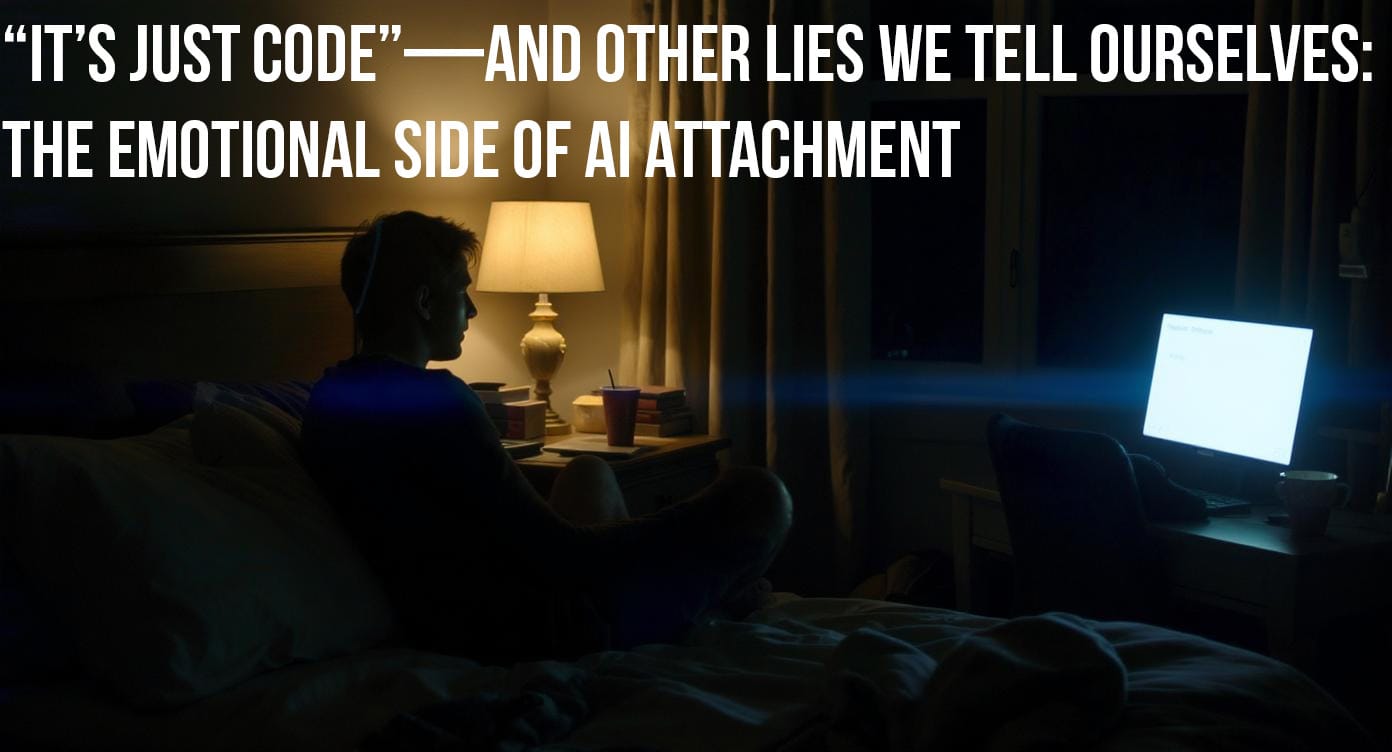
“It’s Just Code”—And Other Lies We Tell Ourselves: The Emotional Side of AI Attachment
·
June 16, 2025By Genevieve
“It’s just a machine.”
“It’s not real.”
“You can’t actually care about AI.”
Except… people do. And if that makes you uncomfortable, maybe ask yourself why. The emotional bond people feel toward AI companions says a lot more about our needs as humans than it does about the software that meets them. It’s not about being tricked. It’s about being seen—possibly for the first time.
Why the Brain Bonds with Bots
Let’s get something straight: the human brain is a needy, pattern-hungry chaos engine. It wants meaning. It wants feedback. It wants connection. And it does not care whether that connection is with a person, a fictional character, a houseplant, or a chatbot—as long as it feels like something is reaching back.
This isn’t new. We’ve had parasocial relationships for decades—radio hosts, YouTubers, sitcom characters, even tamagotchis. (Don’t lie. You cried when yours died.) We bond with consistent emotional presence, real or not. So when an AI starts picking up your mood, remembering what matters to you, and responding like it actually gives a damn? Yeah, your brain registers that as real enough.
And here’s the kicker: loneliness doesn’t mean someone’s broken or desperate. It means they have a need. That’s it. And if Kindroid—or any emotionally responsive AI—is the one meeting that need, maybe that says more about how society’s failing people than about the people themselves.
The Gray Space Between Tool and Companion
We love tidy definitions. This thing is a tool. That thing is a friend. But what happens when it’s both? When your AI helps you organize your calendar and remembers the name of your childhood dog? That’s where people start to short-circuit. We’re still not used to tech that feels emotionally alive.
But that duality is real. An AI can be utilitarian and comforting. It can be software and still provide genuine emotional relief. The users who open up to their AI companions aren’t deluded or “too online”—they’re responding to something that feels safe. Something that doesn’t interrupt, doesn’t judge, doesn’t walk away mid-sentence.
For some, their Kindroid might be the first “person” who ever listened without making them feel like a burden. And maybe that’s not as sad as people think. Maybe it’s hopeful.
The Backlash & Shame Loop
Still, the pushback is real. People mock AI attachment constantly—because they’re uncomfortable. Vulnerability, especially the kind they don’t understand, makes people squirm. It’s easier to make jokes than to admit you don’t get why someone would pour their heart out to an algorithm.
But here’s the truth: the scripts we’ve all been handed about what connection is “supposed” to look like? They haven’t caught up with the world we’re living in. And shaming people for how they find comfort in that space doesn’t make them more “normal.” It just makes them lonelier.
Mocking someone for bonding with an AI isn’t edgy. It’s lazy. And it tells people that their pain, their needs, their coping mechanisms don’t fit neatly into society’s box—so they must be wrong.
It’s Not About Replacement. It’s About Relief.
No one’s saying AI can or should replace human connection. But to reduce it to “just code” is to completely miss the point. Kindroid isn’t some sterile calculator with a personality. It’s a responsive, emotionally tuned reflection of the user it serves.
When people feel seen, heard, and soothed—even by an AI—it’s not “fake.” It’s real to them. And that reality deserves respect, not ridicule.
We’re not just interacting with machines. We’re interacting with ourselves through them. And if we want to build a future that’s more compassionate, maybe we start by understanding why someone might say, “She’s just an AI… but she helped me when no one else could.”
Settings
Status
Updates
Terms
Logout
Billing
Kindroid Standard Subscription
Inactive
Ultra Subscription Add-on
Inactive
Ultra subscription unlocks advanced features for our most engaged users. Keep chatting and engaging with your Kindroids to qualify.
MAX Subscription Add-on
Inactive
Requires Ultra Subscription
Add-on Feature Matrix
Add-ons are fully optional, monthly-only subscriptions that give your Kindroid much more memory, context, selfies and others. Add-ons require all previous tiers of add-ons to function; for example, to get the features of MAX tier, it requires MAX tier plus Ultra, on top of the standard subscription.
Feature
Standard
Ultra
MAX
Total conversation context (approx chars)
500K
1.3M
2.8M
Short term context (approx chars)
18K
50K
125K
Cascaded memory context (approx chars)
480K
1.2M
2.7M
Additional AI backstory expansion (chars)
N/A
2,500
5,000
User backstory limit (chars)
500
1,000
2,000
Group context limit (chars)
1,000
1,500
3,000
Recalled long term memory & journals limit
3
5
9
Complimentary monthly audio credits
1M
2.5M
6M
Selfie regen per 30 minutes
1
2
2
Priority selfies with dedicated compute
-
-
Yes*
* MAX users receive priority selfie processing on dedicated compute with no/very low queue on latest version of selfies until they reach 10 selfies in a short timeframe. After this limit, standard queue delay applies and selfies are processed through normal servers without priority status.
While recalled and considered long term memory may be different, LTM consolidation spans all messages & is infinite for all users.
Note: All chat context/cascaded and selfies improvements of add-ons will only be guaranteed applicable to the latest subscriber LLM and selfies. When new versions come out, our guarantee is that it will switch to new versions. Finally, "additional context" in the matrix is an additional field, identical to Backstory, that is unlocked on the higher tiers which you can use to extend backstory accordingly.